
TCM Remedies for Insomnia: Acupressure, Lifestyle Fixes, and Herbal Formulas That Work
Updated: Oct 15
You lie down. You close your eyes. And then your mind turns on.
Maybe it is the relentless loop of tomorrow's to-do list. Maybe you drift off easily but wake at 3am, staring at the ceiling for no reason you can name. Maybe sleep feels light and unrefreshing, no matter how many hours you get.
If any of this is familiar, you are not alone — and you are not broken. What you may not know is that insomnia has a long history in classical medicine.
Long before sleep trackers and prescription sedatives, TCM practitioners were identifying the root causes of sleeplessness and matching them to specific herbal remedies, acupoints, and daily habits.
A herbal remedy for insomnia in the TCM tradition does not just knock you out. It addresses why sleep eludes you in the first place.
This post walks through the TCM view of insomnia, acupressure points you can try tonight, the lifestyle adjustments that support lasting change, three classical herbal formulas used and well-documented in the TCM tradition for sleep disorders.

How TCM Understands Insomnia
In TCM, sleep is governed by the Shen (神) — often translated as the mind or spirit — which is housed in the Heart.
When the Heart is calm and nourished, the Shen settles at night and sleep comes naturally.
When the Heart is disturbed, deficient, or overheated, the Shen becomes restless, and the mind will not quiet.
Three patterns account for most cases of insomnia:
1. Heart and Kidney disharmony
In TCM physiology, the Heart belongs to Fire and the Kidneys belong to Water. Normally these two communicate and balance each other — Water cools the Heart's fire, and Heart fire warms the Kidney water.
When this relationship breaks down, Heart fire rises unchecked while Kidney water runs cold below.
The result: a racing mind at night, vivid or disturbing dreams, palpitations, night sweats, low back weakness, and a feeling of heat in the chest and palms.
This pattern is very common in people under chronic stress and in those past middle age, as Kidney essence naturally declines.
2. Liver Qi stagnation with heat disturbing the Shen
The Liver in TCM governs the smooth flow of Qi throughout the body and is the organ most directly affected by emotional stress.
When Liver Qi stagnates — as it does when frustration, anger, or prolonged anxiety go unresolved — it generates internal heat.
That heat rises and agitates the Shen.
People with this pattern often find it hard to fall asleep, lie awake with a busy mind, feel irritable before bed, and may notice headaches or a bitter taste in the morning.
Waking between 1am and 3am is also associated with Liver imbalance, as this is the Liver's peak time in the TCM body clock.
3. Heart Blood or Spleen deficiency
The Spleen in TCM is responsible for transforming the food we eat into Blood and Qi. The Heart depends on a steady supply of Blood to nourish and calm the Shen.
When the Spleen is weak — from overwork, poor diet, worry, or irregular eating — it produces insufficient Blood, and the Shen goes undernourished.
This pattern shows up as difficulty staying asleep, light and dream-filled sleep, fatigue, poor memory, pale complexion, and a tendency to worry. It is especially common in people who work long hours, eat irregularly, or spend a lot of mental energy on anxious thought.
You may recognise yourself in one pattern more clearly than another. You do not need to diagnose yourself precisely — even a rough sense of your pattern helps you make better choices with the formulas and habits that follow.
Acupressure Points to Try Tonight
You do not need needles to begin. These three acupoints are well supported in the classical literature for calming the Shen and can be stimulated with gentle finger pressure at home.
For each point, use your thumb or index finger to apply steady, moderate pressure. Hold for 1–2 minutes while breathing slowly and deeply. Both sides of the body can be worked. Evening is the best time.
HT7 — Shenmen (Spirit Gate)
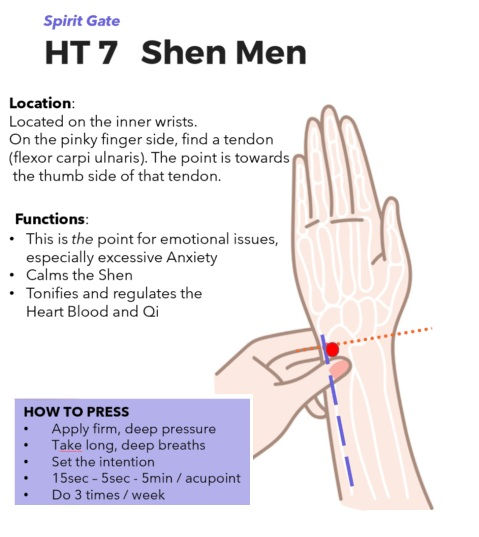
Location: On the inner wrist crease, at the little-finger side. Find the crease where your wrist meets your hand, then slide your finger toward the little finger side until you feel a small hollow just inside the tendon.
Why it works: HT7 Shenmen — "Spirit Gate" — is the primary point of the Heart meridian and one of the most used points in TCM for calming the mind. It directly sedates excess Heart energy, quiets mental agitation, and helps anchor the Shen. It is especially effective for the racing thoughts and palpitations associated with Heart and Kidney disharmony or Liver heat patterns.
How to use it: Press gently into the hollow, hold with slow circular pressure, and breathe out as you press. Many people feel a mild warmth or release spreading up the forearm.
PC6 — Neiguan (Inner Pass)

Location: Three finger-widths above the inner wrist crease, between the two tendons running down the centre of the forearm. Press gently between the tendons.
Why it works: PC6 Neiguan is the point of the Pericardium meridian, which in TCM acts as the Heart's protective minister. Neiguan opens the chest, calms the Shen, regulates Heart Qi, and settles the anxiety and emotional agitation that make sleep impossible. It is also deeply effective for the chest tightness and palpitations that accompany stress-driven insomnia.
How to use it: Apply firm, steady pressure and hold. PC6 responds well to slightly deeper pressure than HT7 — lean in until you feel a mild ache or tingling, then hold and breathe.
SP6 — Sanyinjiao (Three Yin Intersection)

Location: On the inner leg, four finger-widths above the inner ankle bone, just behind the shin bone (tibia). Press gently against the back edge of the bone.
Why it works: SP6 Sanyinjiao is the intersection of the Spleen, Liver, and Kidney meridians — three of the organs most implicated in insomnia. It nourishes Yin and Blood, calms the Liver, supports the Spleen's production of Blood, and grounds rising heat. It is particularly effective for the Blood and Yin deficiency patterns, and it is one of the most broadly useful points in the TCM system for sleep.
How to use it: Press gently upward against the shin bone. Hold for 1–2 minutes each side. Note: this point is traditionally avoided during pregnancy.
Lifestyle and Food: Supporting Sleep the TCM Way
Acupressure techniques work best when the habits that created the imbalance are also addressed. These are not complicated changes — they are adjustments that bring daily life into closer alignment with the body's own rhythms.
Protect the Shen after 9pm
TCM considers excessive mental stimulation in the evening a direct cause of Shen agitation.
Heated conversations, stressful news, and — yes — screens emit a kind of energy that keeps the mind activated when it should be winding down.
Whatever helps your mind soften before bed is not a luxury; in TCM terms, it is medicine.
Eat foods that nourish the Heart and calm the mind
Several foods are specifically valued in TCM for their Shen-settling properties:
Longan nourishes Heart Blood and is used in classical formulas like Gui Pi Tang for exactly this purpose.
Lotus seeds tonify the Heart and calm anxiety.
Lily bulb nourishes Lung and Heart Yin and is used in classical formulas for restless sleep with mild heat.
Red dates (Jujube) support the Spleen's production of Blood.
A simple warm drink made from a handful of lotus seeds, a few red dates, and longan flesh, simmered for 30 minutes, is a classical home remedy for sleep that has been used for centuries.

You can also explore our medicinal food recipes for kitchen-ready preparations that complement these habits, particularly our Liver Cleanser Drink if you often wake up between 1am and 3am due to Liver imbalance.
Sleep before 11pm
The TCM body clock assigns the hours between 11pm and 1am to the Gallbladder, and 1am to 3am to the Liver.
These are the hours when Qi consolidates and Blood returns to the Liver for restoration.
Staying awake past 11pm regularly depletes the Liver Blood over time — and a Liver Blood deficiency is itself a cause of insomnia.
Earlier sleep is a preventive act, not just a preference.
Warm foot soaks before bed
Soaking the feet in warm water for 15–20 minutes before sleep is a classical practice for drawing Yang energy downward — counteracting the tendency for heat and nervous energy to rise and disturb the mind.
Adding a small handful of dried Mugwort leaf to the water is a traditional enhancement. Even plain warm water works.

Herbal Remedies: Classical TCM Formulas for Insomnia
The following three formulas are among the most used and well-documented in the TCM tradition for sleep disorders. Each addresses a different root pattern.
Note: Classical herbal formulas contain multiple herbs working together. They are available as prepared pills or granules from TCM suppliers and pharmacies. For best results, consult a qualified TCM practitioner who can confirm your pattern and adjust the formula to your constitution.
Tian Wang Bu Xin Dan — Emperor of Heaven's Heart Tonifying Pill
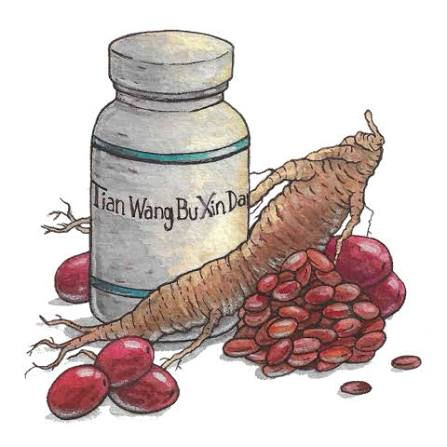
Pattern addressed: Heart and Kidney disharmony; Yin and Blood deficiency with internal heat.
This is one of the most celebrated formulas in the TCM pharmacopoeia for insomnia. Its name — Emperor of Heaven's Heart-Nourishing Pill — reflects both its classical prestige and its primary action: deeply nourishing the Heart and Kidney Yin while clearing the deficiency heat that keeps the mind restless.
Key herbs include:
Rehmannia root - tonifies Kidney Yin and cools Blood.
Sour jujube seed - calms the Shen and is the single most important TCM herb for insomnia.
Arborvitae seed - nourishes Heart Blood and quiets the mind.
Polygala root - opens the Heart's orifices and settles the mind.
Red sage root - moves Blood gently and clears Heart heat.
This classical formula is well suited to: persistent insomnia, night sweats, palpitations, dry mouth at night, a mind that overheats rather than simply fails to slow down.
Suan Zao Ren Tang — Sour Jujube Decoction

Pattern addressed: Liver Blood deficiency with heat; deficiency taxation (chronic depletion from overwork).
This is a deceptively simple five-herb formula from Zhang Zhongjing's Treatise on Cold Damage Disorders — one of the oldest and most trusted formulas in the classical canon. It was designed specifically for the person who is exhausted but cannot sleep, which is the classic presentation of someone who has worked hard for too long and depleted their Blood reserves.
Key herbs include:
Sour jujube seed - in a substantial dose used to nourish Liver Blood, anchor the Shen, and clear the deficiency heat that rises when Blood is low.
Poria - calms the mind and strengthens the Spleen.
Anemarrhena - clears deficiency heat.
Lovage Rhizome - moves Qi in the Blood and relieves the restlessness that comes with Blood stagnation.
Licorice root - to harmonise all herabs in the formula.
This classical formula is well suited to: exhausted but wired, difficulty falling asleep, waking at 3am, mild anxiety and irritability, overwork-related insomnia, post-illness depletion.
Gui Pi Tang — Restore the Spleen Decoction

Pattern addressed: Heart Blood and Spleen Qi deficiency; deficiency of Qi and Blood failing to nourish the mind.
Where the previous two formulas focus primarily on Heat and Yin deficiency, Gui Pi Tang addresses the insufficient production of Blood — the Spleen not doing its job. It is a warming, building formula rather than a cooling one, and it is not appropriate for people with significant internal heat.
Key herbs include:
Ginseng root or Codonopsis - tonifies Qi and support the Spleen's transformative function.
Astragalus - raises and consolidates Qi.
Angelica root - nourishes Blood.
Longan - tonifies Blood and directly calms the mind.
Sour jujube seed- nourishes Liver Blood and anchors the Shen.
Polygala root - - opens the Heart's orifices and settles the mind.
The formula builds the substrate — Blood and Qi — that the Heart needs to house the Shen at night.
This classical formula is well suited to: light or dream-disturbed sleep, waking unrefreshed, fatigue and poor concentration through the day, tendency to worry, pale lips or complexion, poor appetite, loose stools — insomnia rooted in depletion rather than heat.
When to See a TCM Practitioner?
Self-care goes a long way. But there are situations where working with a qualified TCM practitioner is the right next step.
If your insomnia has been present for more than three weeks without improvement despite dietary and lifestyle changes, a practitioner can identify your precise pattern and prescribe a tailored formula — the formulas above are starting points, but the full clinical picture may require modification.
If your insomnia is accompanied by significant anxiety, depression, or panic, or if it is severe enough to affect your safety (driving, working), please do not rely on self-care alone. If you are on medications, particularly cardiac or psychiatric medications, consult a practitioner before adding any herbal formula.
Getting better sleep is not a small thing. It affects every other aspect of health. If you are struggling, reaching out to a trained practitioner is an act of good self-care, not a last resort.

A Final Word
The classical aphorism that BetterThanCure.net is built around — "The sage treats the disease yet to arise, not the one manifested" — applies nowhere more clearly than sleep.
Chronic insomnia rarely arrives suddenly. It builds slowly, through years of overwork, irregular habits, unprocessed stress, and a gradual depletion of the resources the body needs to rest.
TCM catches this process early, before the depletion becomes damage.
Whether you try a single acupoint tonight or begin exploring a classical formula with a practitioner's guidance, the principle is the same: you are working with the body's own intelligence rather than overriding it.
That is the whole philosophy of preventive health. And it is the approach BetterThanCure.net was built to share.
Explore our insomnia remedies section for more health guides that complement what have been shared in this post.
Subscribe to our mailing list to receive new TCM health guides as they are published.
Disclaimer: This article is for educational purposes only and does not constitute medical advice. If you are experiencing persistent sleep difficulties, please consult a qualified TCM practitioner or healthcare provider.


Comments